I wrote this piece in 2011 about a wonderful teacher who taught me about the civil rights movement as a college student. After two plus decades, I saw him frequently during the last year when I came back to John Carroll University as a teacher. He was older and grayer but still inspiring.
I'm reposting it even though it's not Black History Month because Rev. Valentino Lassiter died last night. I'm so very sad and so very glad his life touched mine and the lives of so many others. He is irreplaceable but lives on in many of us as do all great teachers. Godspeed, Rev. Lassiter.
Fuel Someone Different
February, 12, 2011
During my senior year in college, I took a course on the history of the civil rights movement, taught by one of the few African American professors on campus. Like many in his generation, he participated in the movement. He volunteered, organized and marched with the greats, felt the triumphs and the heartbreaks, and was still plugging away in the early 1990s at shaping the future through his teaching.
I had reached that point in my education without learning much about the movement and Martin Luther King, Jr., so
I devoured everything he had to offer. I was enthralled by every lecture, every speech, every letter and every book. I simply loved every bit of it.
At the end of the semester, I finished my exam early and began to walk out of the class. The professor followed me and asked if I have a minute to talk. Standing just outside the classroom, he said, "Don't stop now," referring to my upcoming graduation.
While I don't remember exactly what followed, the essence of his words was something like this: Use your brain and your heart. Learn more and do more. There are scholarships out there. Go on and get graduate degrees and share what you know. There's no limit to what you can do.
I was floored. I had no idea he thought highly of my ability. I was flattered and grateful that he intentionally reached out to me to encourage me and let me know he had high hopes and expectations for my future.
I was particularly touched because very few people had taken the time to say such things to me—not in this country.
Ten years earlier, I was the awkward kid who couldn't make it through the school day without consulting my thick Arabic-English dictionary. I knew precious little about American history or culture. I was an immigrant who looked, dressed, spoke and acted a bit strangely for the all-American kids in my suburban school, which made friendships, compliments and plain old conversation difficult to come by.
Most likely, this professor does not remember me or what he said to me. But to this day, I still remember and I marvel at how such kind words can give a young person so much fuel to go out into the world and make a difference.
When was the last time you encouraged, praised or set high expectations for a young person? Start with the people you see every day--the intern at the office, a young associate, a fast food worker, your child’s classmate, and so on.
One last thing...In honor of Black History Month and in this time of strong anti-immigrant rhetoric, make a point of reaching out to someone who's different--in skin color, ethnicity, language, religion, or whatever. You may just fuel something or someone awesome.
Saturday, June 13, 2015

Monday, May 12, 2014
America the Savior

Growing up in war-torn Lebanon in the 1970s and 1980s, my family was on the side of Beirut that liked, or rather loved, America and Americans. (Yes, there is such a place in the Middle East, or at least there was.)
What we knew came from television and movies, but what we felt came from somewhere inexplicable. At least in my family, we always knew America, with its people, technology, culture and of course political clout, was an amazing place.
We felt there was little America and Americans couldn't do and we desperately needed them to do something to save us from our miserable, fearful existence.
In the dark, long days and nights of the Lebanese civil war, we longed for America to come to our aid. And America came twice. Once America came in the form of the US Marines. They were so welcomed, admired and truly adored (by many) until one fateful morning in 1983 when those doing the bidding of the Syrian and Iranian regimes killed 241 of them and put an end to their comforting, hope-inspiring presence.
 |
| Beirut Memorial at Camp LeJeune |
But as the war raged on, America stopped coming.
Then later in 1984, on a rare, quiet spring morning after a sleepless night of shelling, my parents woke me and my siblings to ask us one question: If we could leave for the United States, would you want to go? The answer was a quick and unanimous yes. After trips to the U.S. Embassy and the American University of Beirut Hospital, we were awarded visas and cleared for travel to the U.S. Little more than two months later, we had sold almost everything we owned, said our goodbyes and were on our way.
And so we came to America.
What we found in America was much more than what the world sees in movies and on television. We found a people with a generous spirit and unlimited kindness; we found endless potential for those who dare to dream and limitless results for those who work on their dreams. We found a place with plenty of bad and more of the good, a place always evolving to become a better version of itself, a place where the future holds enormous promise. Simply put, we fell in love with this amazing country.
I am so grateful for all that I found and I'm even more grateful for the freedom from the fear that dominated my childhood. Almost 30 years later, I believe now more than ever that there's little America and Americans can't do.
But as much as I love this country, I'm filled with sadness as I look at the devastation in Syria. I'm sad and appalled that America hasn't come for the Syrians as it came for us. I worry that Syrians who survive this insane war may never know the America I found. I worry that by walking away from the people of Syria and allowing hundreds of thousands to be killed and millions to be displaced, America itself is diminished. My America is better than that. I still have hope that she will live up to her own standard of greatness, and I pray the Syrian people will see and feel this greatness first hand.


Monday, February 3, 2014
Inhumanity and the Moral Limit in Syria
I wrote this piece for the Cleveland Plain Dealer about Syria. I welcome your feedback.
Laura


Laura
Inhumanity and the moral limit in Syria
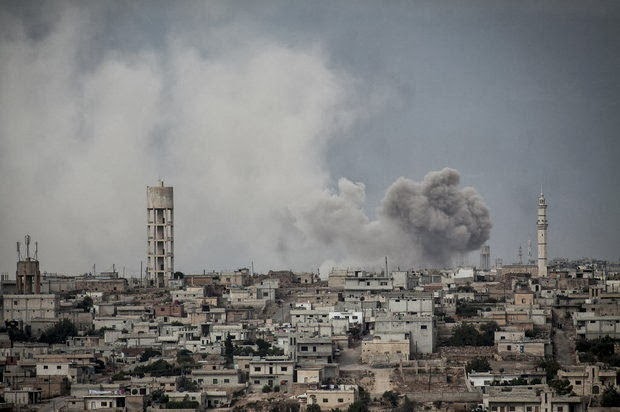 |
In this September 2013 photo, smoke rises after a TNT bomb was thrown from
a helicopter, hitting a rebel position during heavy fighting between troops loyal
to president Bashar Assad and opposition fighters, in the neighbouring village
of Kafr Nabuda, in the Idlib province countryside, Syria.(AP)
|
By
February 01, 2014
At the
start of the “Arab Spring”, I was so optimistic about the prospect of democracy
in the Middle East and heartened by the uprisings in Tunisia and Egypt. On my mind was the oppression of millions of
Syrians by the brutal Bashar Assad regime.
Also on my mind was my experience during Lebanon's civil war and the
enormous damage the Syrian regime did there.
For 10 of
Lebanon’s 15-year civil war, my siblings and I outran bombs to reach home from
school, took tests while watching sniper bullets bounce off of the building
next-door, heard and felt that terrifyingly loud sound of exploding bombs,
spent long days and nights in rat-infested shelters; and of course dealt with
the poverty and degradation of being refugees—not to mention the repeated damage
to our family's home and grocery store, navigating off-limits streets and
intersections targeted by snipers and so much more. These horrors probably make anyone who's had a
normal childhood cringe.
But
here's the bad news: What the Assad regime has done to its own people since
March 2011 is far more brutal, destructive and degrading than the enormous
damage it did in Lebanon. I never imagined this was possible, but it turns out
there's no limit to the regime's inhumanity.
Syria's
numbers today are astounding: 130,000 dead (including thousands of children),
more than 575,000 injured, nearly three million refugees outside Syria, nearly
five million refugees displaced inside Syria; 43,000 Syrians detained and
thousands suffering from starvation and lack of shelter. Then there are the
latest revelations of Holocaust-like torture of thousands.
I suspect
these numbers are conservative and don't account for the destruction of entire
villages and cities and the fear, pain and hopelessness millions of Syrians are
enduring every day.
When the
uprising began, I naively thought that once the world community sees the real
Assad regime, something would happen to remove it from power and Syrians would
finally have a dignified life. I thought what kept Western countries from
looking into the atrocities committed by the regime for the past four decades
was the nearly perfected, sophisticated, lying facade of the Assad family and
their apologists. Once the truth was revealed, I was sure things would change.
Fast
forward to January 2014. Thanks to traditional and social media, the world is aware
of the massacres and we continue to see horrifying images of mutilated bodies,
rows of dead children and so much more. My hat is off to saintly aid workers
and journalists, but the rest of us do nothing to stop the madness. Where is
our outrage? Where is our humanity?
Where is the world's conscience? Have we become numb to the images of the
suffering, torture and mutilation?
Forget
the fiasco about red lines and chemical weapons. And, forget the peace talks in
Geneva, which are unlikely to be productive as long as Assad is in power. The
fact of the matter now is clear as day: The world knows Assad's brutality well
and does not care.
I don’t
claim to have the answers to the difficult and complicated geopolitical
considerations, but I know two things must happen: The bloodshed must be
stopped and the criminal regime must be removed and punished.
I
understand the plight of Christian minority inside Syria. And, yes, Iran,
Russia, Israel and the American public make military action difficult. But when
does it all stop? Teams of experts
reviewing the recently released torture archives have made a direct comparison
to the Holocaust. Are we waiting until
the number of dead Syrians reaches six million?
Has the world learned nothing from Holocaust? Shame on every world leader and on every one
of us for not doing more, for not caring more, and for not demanding the end to
this holocaust.
In the
words of the late journalist and author Christopher Hitchens (who was writing
in 2010 about Henry Kissinger's reference to gas chambers on the Nixon tapes),
"There has to be a moral limit, and either this has to be it
or we must cease pretending to ourselves that we observe one."
So, does my beloved country have a moral limit
when it comes to Syria? Does the world?
Boustani
is a Lebanese-American who immigrated to the United States from Lebanon in the
1980s.
Thursday, August 29, 2013
Rations, Wishes and the Syrian Regime
 |
| Photo is courtesy of the Facebook page We are all Hamza Alkhateeb. |
I wrote this many years ago. Hafez al-Assad's son is now gone. I pray that Syria rises as a country that's rich with ethnic and religious minorities. Syrians shouldn't accept anything less.
**************************************************************************
With Syria on my mind, I stopped at a local restaurant for takeout falafel for lunch yesterday. The owner, a Syrian immigrant, is usually happy to serve up a side
of politics with my lunch. Yesterday's side was a little different. I asked her
what she thought of the current talk of the U.S. attacking the Syrian regime.
She expressed her concern for civilians but said it has to be done. She went on
to tell me that she believes the Americans will aim for precise targets and do
what they can to spare civilians' lives. As we waited for my falafel to cook, she leaned over the counter
to tell me about food shortages and the financial struggles of her friends and
family in Syria. I asked about water and electricity which she confirmed are
scarce. I then shared that my family experienced very similar struggles courtesy
of the Syrian regime during the Lebanese civil war. She shook her head in
disgust.
As she packed my pita bread, I shared the story of my mother and I
waiting in line for many hours for flour in Beirut to bake our own bread (unheard
of in a city the size of Beirut but bakeries were closed). This was one of the
many occasions when the army of the first Assad shelled Lebanese roads and
bridges closing supply routes and forcing the rationing of what little was
available. She seemed a bit surprised but I realized that I was speaking to
someone who's heard about but not experienced the realities of war.
I should have stopped there, but I went on to share one more
thing. I told her that my wish as a child was for my parents to let me leave
home so I can make my way to Syria and personally kill Assad. Yes, I said that.
I personally wanted to kill Assad to put an end to the suffering of so many,
particularly my family. I was confident (or foolish to think) I could reach
Syria somehow and get close enough to kill him. Fortunately or not, my wise
parents did not agree and I did not get my wish. The woman looked at me
puzzled, shook her head and said, "I have never heard anything like this
before." Her response bothered me but I'm not sure why. I suspect Syrian
children living through their war now more easily identify with my childhood
experiences and state of mind.
But what if I did leave home, reached Damascus and made my wish
come true? One thing is for sure; I wouldn't be here writing about it today.
Today, as a Lebanese American, I'm praying that my country
delivers decisive, definitive and devastating strikes to the son of Assad and
his lieutenants. I'm also praying that Syrian children will live to write and
talk about it.
Tuesday, April 30, 2013
Fidelity and Betrayal
 |
| Boston Marathon bombing - April 15, 2013 |
I posted the piece below a while back but I thought to share it again for obvious reasons. It is by no means a putdown of immigrants' loyalty to the United States. (I dare anyone to take me up on that point.) Rather, it's my story and my way of expressing my anger toward those who pledged their loyalty to this great country and then proved themselves unworthy of the privilege of American citizenship. Unforgivable.
_______________________________________________________
 |
| Beirut's Green Line |
But we were grateful to be in America. We were grateful for a full night's sleep, safe streets, law and order, open schools and what we felt was a clear path to a real future. I'm grateful to be alive and here today to write this blog. I know I speak for each family member when I say we simply fell in love with this country--its ideals, its history and its people. The kindness of countless Americans helped us through so many challenges, and it didn't take long for us to feel we were home.
 |
| A US Naturalization Ceremony |
I know our story is essentially the same as that of countless immigrants from every corner of the globe who chose this country and have become (or are in the process of becoming) woven into its glorious fabric. It's probably safe to say that throughout America's history, immigrants have returned every bit of kindness and every ounce of opportunity offered to them by this great country. They have paid back with hard work, ingenuity and fidelity.
Yes, fidelity is really what's on my mind today. As I learn more about two naturalized American citizens--Mansour Arbabsiar, the man at the center of an alleged Iranian plot to kill a Saudi diplomat in Washington, and Mohamad Soueid, who was indicted yesterday for acting as an agent of the Syrian government and spying on Syrian protesters in America, I'm outraged and disgusted. We don't quite know either man's motivation yet, but we do know they were both lured by foreign governments to put American lives in danger and undermine the very basic rights and liberties guaranteed to all in this country.
I am grateful that law enforcement officials found these two individuals and that they're now in the hands of our justice system, but the words of that oath are haunting me. Did they mean anything they said the day they raised their hands and became American citizens? Clearly not.
Below is the actual Naturalization Oath of Allegiance to the United States of America. Whether you're a naturalized or native American citizen, please read it carefully and renew your commitment. Let's all return every bit of kindness and every ounce of opportunity offered to us by this great country.
Oath
"I hereby declare, on oath, that I absolutely and entirely renounce and abjure all allegiance and fidelity to any foreign prince, potentate, state or sovereignty, of whom or which I have heretofore been a subject or citizen; that I will support and defend the Constitution and laws of the United States of America against all enemies, foreign and domestic; that I will bear true faith and allegiance to the same; that I will bear arms on behalf of the United States when required by the law; that I will perform noncombatant service in the armed forces of the United States when required by the law; that I will perform work of national importance under civilian direction when required by the law; and that I take this obligation freely without any mental reservation or purpose of evasion; so help me God."
Laura
Thursday, March 21, 2013
A New Middle East
As President Obama visits Israel, I have more thoughts and blog posts brewing in my head than I have time to write, but it occurred to me that I should have titled the piece below "A Modest Proposal for a New Middle East". Scroll down under for the November 2011 post.
 |
| Israeli President Shimon Peres shows President Obama an olive tree at the presidential palace on March 20, 2013. Pablo Martinez Monsivais/AP |
(And here's the transcript of the speech the President gave in Israel today. Brilliant!)
November 15, 2011
A Modest Proposal for a New Arab World
The Voice of America's new Middle East site today published this piece I wrote. Take a look and let me know what you think. Click HERE for the VOA site or see the text below.

A Modest Proposal for a New Arab World
By Laura Boustani
There are so many unspoken rules, ancient prejudices, historical tipping points and complicated allegiances in Arab politics. Most of them have a great deal to do with religion and little to do with human rights, equality or freedom. In fact, hating and oppressing all the “others” is a time-honored Arab tradition.
Shiites oppress Sunnis and Sunnis oppress Shiites. Christians are oppressed in most Arab countries and arguably oppressive in one. Palestinians are personae non gratae just about everywhere, but their cause is front and center for militants who use it to justify attacking Israel. Most al-Qaida and Hamas members appear to be Sunni. Hezbollah members and Iranians are Shiites. Jews seem to be everyone’s enemy.

Are you confused yet? You’re not alone. It’s maddening, but those of us from that part of the world have no problem keeping all this straight. Much of it explains our past, defines our present and shapes our future. In fact, much of the current unrest in Arab countries is a direct result of the connection between religious identity and power. And, let me be clear: Probably all religions and sects are guilty of exploiting their faith to commit countless atrocities – if not currently, then it is likely to have happened at some point in history.
I began this piece wanting to argue that Christians in Syria and Lebanon should wholeheartedly support the Syrian revolution and stand on the side of human rights, freedom and dignity for all, regardless of their fears. But I realized that any such argument will fall on deaf ears if religious affiliation, oppression of the “others”, and fear always come first.
So, to borrow from Jonathan Swift, here’s my modest proposal for a new Arab world that rejects the modus operandi of past centuries:
1. Separate religion from all affairs of a nation and grant everyone the right to worship as they wish.
2. Recognize the inherent worth and dignity of every person and grant all citizens the same rights regardless of their religious beliefs, gender, political affiliation or family history.
3. Give everyone equal say on who they trust to serve them at every level of government. Yes, free and fair elections are a must.
4. Value and protect everyone’s right to express their opinions and associate with whomever they please.
5. Administer equal justice to all according to fair laws approved by citizens.
Perhaps what I’m suggesting is simply for Arab countries to weave into the fabric of their new nations a universal teaching of all the world’s great religions, the Golden Rule, or the ethic that we are to treat other people as we would wish to be treated ourselves.
Can it be that simple?
As the American revolutionary Thomas Paine once said, “We have it in our power to begin the world over again.” So, why don’t we?
Tuesday, November 6, 2012
Dreaming on Election Eve
On this election eve, I am filled with hope and anxiety over what may happen tomorrow. I've decided to let hope win as I contemplate going to bed. I pray my glorious country's future will be better than its past in every way imaginable. This poem by Langston Hughes says it best.

Dream A World
I dream a world where man
No other man will scorn,
Where love will bless the earth
And peace its paths adorn
I dream a world where all
Will know sweet freedom's way,
Where greed no longer saps the soul
Nor avarice blights our day.
A world I dream where black or white,
Whatever race you be,
Will share the bounties of the earth
And every man is free,
Where wretchedness will hang its head
And joy, like a pearl,
Attends the needs of all mankind-
Of such I dream, my world!
Langston Hughes
Subscribe to:
Posts (Atom)